Source trade show table cloth for Advertising, Promotion, Trade Show Display
Find 30 options for trade show table cloth featuring polyester and spandex materials with customizable sizes and designs. Buyers can compare single or double-sided printing, eco-friendly certifications, and OEM services for advertising and promotion needs.
Key considerations
Products List




Comprehensive Sourcing Guide
Strategic Sourcing Guide for Trade Show Table Cloths
Understanding Technical Specifications and Material Variations
When sourcing table cloths for trade show environments, buyers must navigate a complex landscape of material compositions and printing technologies. The core product category encompasses items designed for high-visibility advertising and promotional display, where durability and aesthetic appeal are paramount. Based on current market data, the primary material base for these products is often polyester, specifically in forms such as Spandex Polyester or Knitted Polyester. These fabric choices are selected for their ability to drape smoothly over standard table dimensions while resisting wrinkles during transport and setup.
A critical technical distinction lies in the printing method employed. The market features two dominant approaches: Heat Transfer Printing and Sublimation Printing, alongside Digital Printing options. Sublimation printing is particularly favored for full-color, vibrant designs as it allows the ink to bond with the polyester fibers, resulting in a print that does not crack or fade easily. Conversely, Heat Transfer Printing offers a robust alternative for specific design requirements. Buyers should verify which method is utilized for their specific order, as this impacts the final texture and colorfastness of the cloth.
The physical dimensions of the table cloth are rarely one-size-fits-all. Specifications indicate that sizes are typically customized, with standard offerings including 6ft configurations or specific dimensions like 30x180cm. However, the "Customized" attribute is a recurring specification, meaning buyers should expect to provide exact measurements for their booth tables. The shape is predominantly rectangular, though some variations may exist. The weight of the product is another variable; observed data suggests a range from approximately 0.5kg to 1kg per piece, with fabric weights (GSM) varying significantly between 110GSM and 260GSM. Thicker fabrics generally offer better opacity and a more premium drape, while lighter options may be preferred for shipping efficiency.
Compliance, Certification, and Safety Standards
For international trade show procurement, verifying compliance with safety and environmental standards is non-negotiable. The supplied product data highlights several certifications that buyers should look for to ensure the materials meet global safety requirements. These include Eco-Friendly status, SGS certification, ISO standards, and En71 compliance. The presence of these certifications suggests that the materials have undergone testing for toxicity, flammability, and general safety, which is crucial for indoor exhibition spaces where crowd density is high.
Specifically, the En71 standard is a critical benchmark for product safety, often relevant for items that may come into contact with skin or be used in environments with children. ISO certifications, such as ISO 9001:2008 mentioned in specific product contexts, indicate that the manufacturing facility adheres to quality management systems. While some background knowledge references OEKO-TEX, buyers should treat this as a verification point rather than an automatic guarantee, ensuring the specific supplier batch holds this status if environmental safety is a primary concern.
The "Eco-Friendly" attribute implies that the production process or the raw materials may adhere to reduced environmental impact protocols. However, buyers must request specific documentation to substantiate these claims. The "SGS" certification typically covers a broad range of product testing, including physical and chemical safety. When evaluating suppliers, the presence of these certificates should be verified against the specific product batch, as certifications can sometimes apply to the factory's general quality system rather than individual product lines.
Cost Drivers and Pricing Dynamics
The pricing structure for trade show table cloths is influenced by several dynamic factors, primarily customization, material weight, and order volume. The observed price range in the market spans from $2.85 to $99 USD. This wide variance is not arbitrary; it correlates directly with the complexity of the design, the GSM weight of the fabric, and the quantity ordered. Lower-priced items typically correspond to standard sizes with simpler printing methods or lower GSM weights, while the higher end of the spectrum reflects custom dimensions, heavy-duty fabrics, or complex multi-sided printing.
The Minimum Order Quantity (MOQ) is a significant cost driver. Data indicates that MOQs can range from as low as 1 piece to 500 pieces. The "Selling Point" of many suppliers emphasizes "High Quality with Low Price and MOQ," suggesting a market trend toward flexibility for small businesses or first-time buyers. An MOQ of 1 piece allows for prototyping and small-scale testing without significant capital commitment, whereas bulk orders of 500 pieces often trigger volume discounts that significantly reduce the unit cost.
Production time also impacts the final cost structure. The standard production time listed is 24 hours, which is exceptionally fast for custom manufacturing. This rapid turnaround capability often commands a premium or requires specific logistics planning. Buyers must balance the urgency of their trade show schedule against the cost of expedited shipping. Additionally, the "Selling Point" of low price and low MOQ suggests that the market is highly competitive, but buyers should remain vigilant that lower prices do not compromise the quality of the fabric or the durability of the print.
Typical Applications and Functional Requirements
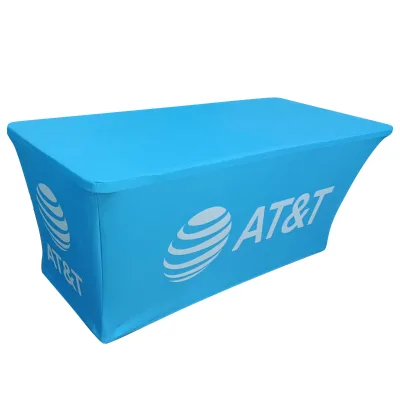
Trade show table cloths serve a dual purpose: functional protection and high-impact advertising. The primary usage categories identified are Advertising, Promotion, and Trade Show Display. In these settings, the table cloth acts as a mobile billboard, covering the table surface to hide clutter and present a unified brand image. The "Customized Artwork" and "Any Design Available" attributes confirm that these products are designed to be fully branded with logos and marketing messages.
Beyond the trade show floor, these products have versatile applications in Home, Hotel, and Outdoor settings. The "Usage" field explicitly lists Outdoor, Home, and Hotel, indicating that the materials are robust enough for varied environments. Functional features such as Waterproof, Oilproof, and High Temperature-Resistant properties are critical for trade show environments where spills are common. The "Disposable" attribute suggests that some variants are designed for single-use events, offering a cost-effective solution for short-term promotions where laundering is not feasible.
The attachment method is another functional consideration. While some products utilize an adhesive method, others rely on the drape and weight of the fabric. The "Scalloped" style mentioned in specific product data adds a decorative element suitable for home or hotel use, whereas the "Rectangular" shape is standard for trade show utility. The "Anti-static" feature is particularly valuable in electronics or high-tech trade shows to prevent dust attraction and protect sensitive equipment.
Supplier Evaluation and Service Capabilities
Selecting the right supplier requires a deep dive into their service capabilities and manufacturing standards. The market data indicates a strong presence of OEM (Original Equipment Manufacturer) and ODM (Original Design Manufacturer) services. The "OEM&ODM: Are Welcome" and "OEM Service" attributes suggest that suppliers are equipped to handle custom branding, from logo placement to full design execution. This flexibility is essential for buyers who need unique branding that aligns with their specific trade show theme.
The production workflow is supported by specific file format requirements, including Ai, Pdf, EPS, and JPG. Buyers must ensure their design teams can provide files in these formats to avoid production delays. The "Craftsmanship" is listed as "Printed," but specific entries also mention "Handmade" techniques, indicating that some suppliers may offer artisanal finishing for premium products. The "Factory Standard Packing" of 1 piece per OPP bag or Polybag ensures that the product arrives protected, though buyers should verify if additional packaging is available for bulk shipments.
Geographic location is a factor in logistics and communication. The observed origins include Shandong, China (Mainland), and Shanghai. These regions are known for textile manufacturing, but buyers should confirm the specific factory location to assess lead times and shipping costs. The "Production Time" of 24 hours is a standout feature, but buyers should verify if this applies to all custom orders or only standard configurations. The "Service" aspect, including OEM support, should be evaluated through direct communication to ensure the supplier can meet specific branding and timeline requirements.
Quality Control and Long-Term Procurement Considerations
Quality control in the procurement of trade show table cloths extends beyond the initial inspection of the fabric. Buyers should focus on the consistency of the printing method, ensuring that the Sublimation or Heat Transfer Printing does not bleed or fade. The "Weight" specifications, ranging from 0.5kg to 1kg, should be verified against the order to ensure the fabric density matches the intended use. For long-term procurement, the durability of the material against repeated washing and exposure to light is crucial.
The "Standard" attributes, such as "SGS, ISO 9001: 2008," provide a baseline for quality management, but buyers should implement their own quality control checks. This includes verifying the "Gram Weight" (20-260GSM) to ensure the fabric is not too thin for the intended application. The "Features" list, including Waterproof and Oilproof, should be tested with sample batches before committing to large orders.
Long-term procurement strategies should consider the scalability of the supplier. With an MOQ as low as 1 piece, suppliers are flexible for small orders, but buyers should assess their capacity to handle larger volumes without compromising quality. The "Selling Point" of low price and low MOQ is attractive, but buyers must balance this with the need for consistent quality over multiple trade show seasons. Establishing a relationship with a supplier who offers reliable OEM services and adheres to strict certification standards will ensure a steady supply of high-quality table cloths for future events.
Comparative Analysis of Product Attributes
To facilitate decision-making, the following table summarizes key attributes observed in the market for trade show table cloths. This comparison helps buyers identify which product specifications align with their specific procurement needs.
| Attribute Category | Common Observation | Variations / Notes |
|---|---|---|
| Material | Polyester | Spandex Polyester, Knitted Polyester |
| Printing Method | Sublimation / Heat Transfer | Digital Printing, Handmade |
| Size | Customized | 6ft, 30x180cm, Other sizes |
| Shape | Rectangular | Scalloped (Decorative variants) |
| Weight | 0.5kg - 1kg / Piece | 110GSM - 260GSM |
| Certifications | SGS, ISO, En71 | Eco-Friendly |
| MOQ | 1 Piece | Up to 500 Pieces |
| Production Time | 24 Hours | Subject to design complexity |
| Packing | 1 Piece Per Polybag/OPP Bag | Custom packing available |
| Origin | China (Mainland) | Shandong, Shanghai |
This structured overview highlights the diversity within the category. Buyers should use this matrix to filter suppliers based on their specific requirements for material weight, printing technology, and certification standards. By focusing on these tangible attributes, procurement teams can make informed decisions that align with their brand image and logistical constraints.
FAQs
What printing methods are available for trade show table cloths?
Sublimation printing and heat transfer printing are the primary methods used. Digital printing is also available for specific designs. These methods ensure vibrant colors that bond well with polyester fabrics for durable trade show displays.
Can I order a single piece of a custom trade show table cloth?
Yes, you can order a single piece as the minimum order quantity is one piece. This allows for prototyping without bulk commitments. Custom sizes and designs are available for this low-volume order.
Which certifications do these table cloths typically hold?
Common certifications include Eco-Friendly, SGS, ISO, and En71. These standards verify safety and quality for international trade shows. Buyers should verify specific batch documentation to ensure compliance with local regulations.
How fast can suppliers produce custom trade show table cloths?
Standard production time is listed as 24 hours for custom orders. This rapid turnaround supports urgent trade show schedules. Buyers must confirm if this applies to their specific design and fabric requirements.
What material options exist for durable trade show table cloths?
Materials include Spandex Polyester and Knitted Polyester for smooth draping. These fabrics offer waterproof and oilproof features suitable for events. Weight varies from 0.5kg to 1kg per piece depending on the GSM.
What file formats are required for custom artwork submission?
Accepted file formats include Ai, Pdf, EPS, and JPG. These formats ensure high-quality printing of logos and designs. Buyers must provide files in these formats to avoid production delays.